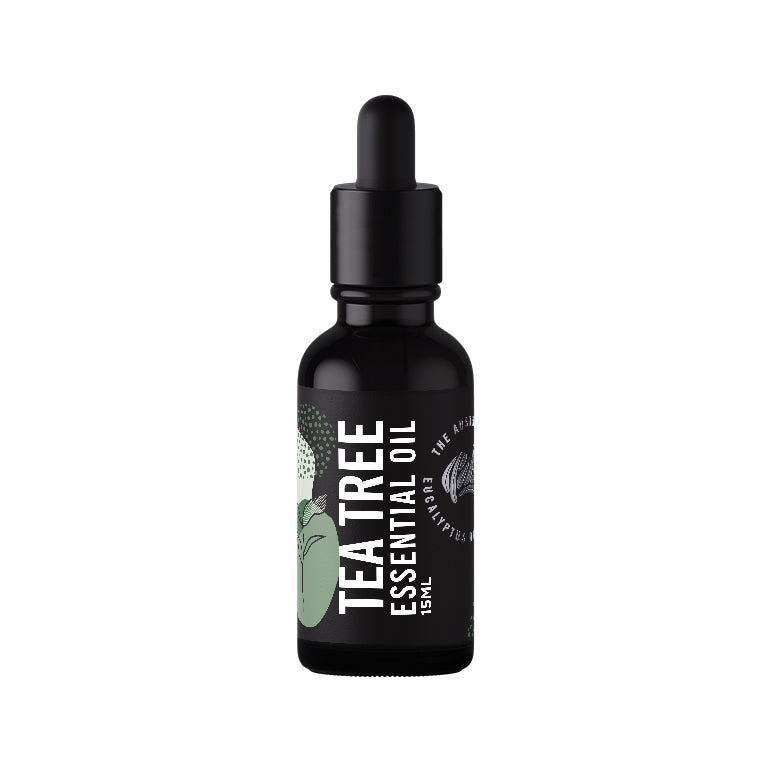
Smells incredible. The quality is exactly what they say it is.
Tea Tree is the oil that should be in every spray bottle in the house. The bathroom. The kitchen. The laundry. The gym bag. The pet bedding. It's the most practically useful oil in this range and the one that most people own one small bottle of and treat like medicine rather than a household staple.
Some essential oil brands charge over $60 for 15ml of Tea Tree. At that price you use it for skin spots and nothing else. You don't put it in a spray bottle. You don't add it to the washing machine drum. You don't use it for everything it was built for because it feels too expensive to be that casual with.
At our price you fill the spray bottles. All of them. You use it generously because that's how it works — not three careful drops but a proper working concentration in a proper spray.
That's the shift. Not the oil. What the price lets you do with it.
100% pure Tea Tree oil. Nothing added, nothing diluted. We've been selling pure essential oils since 1895. If it's not the best Tea Tree you've smelled, we'll refund you in full. No return, no questions, no expiry on that promise.
Some essential oil brands charge over $60 for 15ml of Tea Tree. At that price you use it for skin spots and nothing else. You don't put it in a spray bottle. You don't add it to the washing machine drum. You don't use it for everything it was built for because it feels too expensive to be that casual with.
At our price you fill the spray bottles. All of them. You use it generously because that's how it works — not three careful drops but a proper working concentration in a proper spray.
That's the shift. Not the oil. What the price lets you do with it.
100% pure Tea Tree oil. Nothing added, nothing diluted. We've been selling pure essential oils since 1895. If it's not the best Tea Tree you've smelled, we'll refund you in full. No return, no questions, no expiry on that promise.
In a diffuser
Add 4–6 drops to your diffuser with water. Run for 30–60 minutes at a time — intermittent diffusing is more effective than continuous. A well-ventilated room gives you the scent without the saturation.
As a roller blend
Add the recommended drops to a 10ml roller bottle and top with a carrier oil. Apply to wrists, temples, the back of the neck, or the sternum. Never apply undiluted essential oil directly to skin except for small targeted spots.
In a spray
Add the recommended drops to 250ml of water with 1 teaspoon of methylated spirits as an emulsifier. Shake before each use. Spray on surfaces, fabrics, or into the air.
For topical use
For targeted spot use, Tea Tree is one of two oils considered safe to apply neat to a small area. For all other skin use, dilute to 1–2% in carrier oil. Avoid contact with eyes and mucous membranes.
Storage
Keep in a cool, dark place — a cupboard or drawer is ideal. Keep the lid sealed between uses. Essential oils degrade with heat, light, and air exposure.
Tea Tree — dilution and caution
Use 4–6 drops in a 100ml diffuser. For targeted spot use, safe to apply neat to a small area only. For all other skin use, dilute to 1–2% in carrier oil. Never apply directly to cats.
Add 4–6 drops to your diffuser with water. Run for 30–60 minutes at a time — intermittent diffusing is more effective than continuous. A well-ventilated room gives you the scent without the saturation.
As a roller blend
Add the recommended drops to a 10ml roller bottle and top with a carrier oil. Apply to wrists, temples, the back of the neck, or the sternum. Never apply undiluted essential oil directly to skin except for small targeted spots.
In a spray
Add the recommended drops to 250ml of water with 1 teaspoon of methylated spirits as an emulsifier. Shake before each use. Spray on surfaces, fabrics, or into the air.
For topical use
For targeted spot use, Tea Tree is one of two oils considered safe to apply neat to a small area. For all other skin use, dilute to 1–2% in carrier oil. Avoid contact with eyes and mucous membranes.
Storage
Keep in a cool, dark place — a cupboard or drawer is ideal. Keep the lid sealed between uses. Essential oils degrade with heat, light, and air exposure.
Tea Tree — dilution and caution
Use 4–6 drops in a 100ml diffuser. For targeted spot use, safe to apply neat to a small area only. For all other skin use, dilute to 1–2% in carrier oil. Never apply directly to cats.
Blend 1: Tea Tree + Lavender + Lemon — "The All-Purpose Spray"
The three-oil cleaning combination that's been reproduced in more natural home recipes than any other — not because it's trendy, because the chemistry actually holds. Tea Tree is broad-spectrum antimicrobial. Lavender adds anti-inflammatory properties to surfaces exposed to skin. Lemon cuts grease and lifts the clinical edge that Tea Tree on its own produces. 5 drops each in 250ml water + 1 tsp methylated spirits. You switched to natural cleaning on principle. This is where the principle and the germ count agree.
Blend 2: Tea Tree + Eucalyptus + Peppermint — "The Mould Spray"
Tea Tree disrupts fungal cell walls via terpinen-4-ol. Eucalyptus adds cineole, which works on a different fungal pathway. Peppermint adds menthol, which inhibits spore germination before they colonise. Three different mechanisms, stacked. Spray on grout, silicone, and the base of shower walls. Leave twenty minutes. Don't rinse. 6 drops Tea Tree, 4 drops Eucalyptus, 3 drops Peppermint in 250ml water + 1 tsp methylated spirits. You've been removing mould. This is what you do before it needs removing.
Blend 3: Tea Tree + Rosemary + Lemon — "The Scalp Oil"
The 2015 study that compared rosemary oil to minoxidil at six months showed equivalent results. That's the context for this blend. Tea Tree clears the follicle. Rosemary is the one with the data. Lemon balances the scalp's pH so the other two can do their work. 4 drops Tea Tree, 4 drops Rosemary, 3 drops Lemon in 20ml carrier oil. Massage into scalp, leave twenty minutes, wash out. Twice a week, consistently. The expensive scalp serum contains three or four actives. Two of them are in this blend. You're paying for the dropper.
Blend 4: Tea Tree + Geranium + Lavender — "The Spot Roller"
You tried Tea Tree neat on a spot once. You got irritation and concluded it doesn't work. The undiluted part was the problem — not the oil. Tea Tree is the antimicrobial. Geranium regulates sebum production. Lavender reduces the redness around the site. All three in jojoba, applied directly to spots with the roller ball. 2 drops Tea Tree, 2 drops Geranium, 2 drops Lavender in a 10ml roller topped with jojoba. The chemistry is the same as a $45 targeted treatment. The jojoba is doing the same job as the branded carrier. You know this now.
Blend 5: Tea Tree + Lemongrass + Orange — "The Pet Area Spray"
Tea Tree deters and its antifungal properties keep bedding clean between washes. Lemongrass repels insects at the citral level — the same mechanism as more expensive pet sprays. Orange cuts the smell that accumulates in the spaces where animals live and sleep. Spray on bedding, around doorways, and on the mat — never directly on the animal. 3 drops Tea Tree, 4 drops Lemongrass, 4 drops Orange in 250ml water + 1 tsp methylated spirits. You've been using a product you weren't sure about on the thing you're most protective of. This is the version you're sure about.
The three-oil cleaning combination that's been reproduced in more natural home recipes than any other — not because it's trendy, because the chemistry actually holds. Tea Tree is broad-spectrum antimicrobial. Lavender adds anti-inflammatory properties to surfaces exposed to skin. Lemon cuts grease and lifts the clinical edge that Tea Tree on its own produces. 5 drops each in 250ml water + 1 tsp methylated spirits. You switched to natural cleaning on principle. This is where the principle and the germ count agree.
Blend 2: Tea Tree + Eucalyptus + Peppermint — "The Mould Spray"
Tea Tree disrupts fungal cell walls via terpinen-4-ol. Eucalyptus adds cineole, which works on a different fungal pathway. Peppermint adds menthol, which inhibits spore germination before they colonise. Three different mechanisms, stacked. Spray on grout, silicone, and the base of shower walls. Leave twenty minutes. Don't rinse. 6 drops Tea Tree, 4 drops Eucalyptus, 3 drops Peppermint in 250ml water + 1 tsp methylated spirits. You've been removing mould. This is what you do before it needs removing.
Blend 3: Tea Tree + Rosemary + Lemon — "The Scalp Oil"
The 2015 study that compared rosemary oil to minoxidil at six months showed equivalent results. That's the context for this blend. Tea Tree clears the follicle. Rosemary is the one with the data. Lemon balances the scalp's pH so the other two can do their work. 4 drops Tea Tree, 4 drops Rosemary, 3 drops Lemon in 20ml carrier oil. Massage into scalp, leave twenty minutes, wash out. Twice a week, consistently. The expensive scalp serum contains three or four actives. Two of them are in this blend. You're paying for the dropper.
Blend 4: Tea Tree + Geranium + Lavender — "The Spot Roller"
You tried Tea Tree neat on a spot once. You got irritation and concluded it doesn't work. The undiluted part was the problem — not the oil. Tea Tree is the antimicrobial. Geranium regulates sebum production. Lavender reduces the redness around the site. All three in jojoba, applied directly to spots with the roller ball. 2 drops Tea Tree, 2 drops Geranium, 2 drops Lavender in a 10ml roller topped with jojoba. The chemistry is the same as a $45 targeted treatment. The jojoba is doing the same job as the branded carrier. You know this now.
Blend 5: Tea Tree + Lemongrass + Orange — "The Pet Area Spray"
Tea Tree deters and its antifungal properties keep bedding clean between washes. Lemongrass repels insects at the citral level — the same mechanism as more expensive pet sprays. Orange cuts the smell that accumulates in the spaces where animals live and sleep. Spray on bedding, around doorways, and on the mat — never directly on the animal. 3 drops Tea Tree, 4 drops Lemongrass, 4 drops Orange in 250ml water + 1 tsp methylated spirits. You've been using a product you weren't sure about on the thing you're most protective of. This is the version you're sure about.
How many drops do I use in a diffuser?
4–6 drops in a 100ml diffuser. Tea Tree is one of the most practical oils for diffusing in a home. Blend it with Lemon or Eucalyptus to lift the medicinal edge. For cleaning sprays, 6–10 drops per 250ml of water is the standard working concentration.
Can I apply it directly to skin for a spot treatment?
Tea Tree is one of two oils most commonly considered safe for neat application to a small, targeted area such as a single blemish or insect bite. For larger area use, always dilute in carrier oil at 1–2%. Repeated undiluted use over time can cause sensitisation.
Is it safe for my dog?
Diluted, diffused use in a ventilated space is generally considered lower risk for dogs. However, Tea Tree is one of the oils with the clearest toxicity data for dogs when applied topically or ingested — even small amounts can cause neurological symptoms in some dogs. Never apply Tea Tree products directly to your dog's coat or skin. For cats, avoid Tea Tree use entirely.
Is it safe during pregnancy?
Tea Tree appears on the generally-considered-safe list from the International Federation of Professional Aromatherapists for pregnancy when used diluted and in moderation. For cleaning use, the incidental exposure from a diluted spray is considered low risk. Avoid internal use entirely.
Is it really more antibacterial than most commercial cleaners?
The antibacterial activity of terpinen-4-ol — Tea Tree's primary active compound — has been well-documented in peer-reviewed research including against E. coli, Staphylococcus aureus, and MRSA. In a diluted home cleaning spray at 1–2%, it's effective for general surface sanitation. It's not a steriliser. It's a practical, documented antibacterial agent.
4–6 drops in a 100ml diffuser. Tea Tree is one of the most practical oils for diffusing in a home. Blend it with Lemon or Eucalyptus to lift the medicinal edge. For cleaning sprays, 6–10 drops per 250ml of water is the standard working concentration.
Can I apply it directly to skin for a spot treatment?
Tea Tree is one of two oils most commonly considered safe for neat application to a small, targeted area such as a single blemish or insect bite. For larger area use, always dilute in carrier oil at 1–2%. Repeated undiluted use over time can cause sensitisation.
Is it safe for my dog?
Diluted, diffused use in a ventilated space is generally considered lower risk for dogs. However, Tea Tree is one of the oils with the clearest toxicity data for dogs when applied topically or ingested — even small amounts can cause neurological symptoms in some dogs. Never apply Tea Tree products directly to your dog's coat or skin. For cats, avoid Tea Tree use entirely.
Is it safe during pregnancy?
Tea Tree appears on the generally-considered-safe list from the International Federation of Professional Aromatherapists for pregnancy when used diluted and in moderation. For cleaning use, the incidental exposure from a diluted spray is considered low risk. Avoid internal use entirely.
Is it really more antibacterial than most commercial cleaners?
The antibacterial activity of terpinen-4-ol — Tea Tree's primary active compound — has been well-documented in peer-reviewed research including against E. coli, Staphylococcus aureus, and MRSA. In a diluted home cleaning spray at 1–2%, it's effective for general surface sanitation. It's not a steriliser. It's a practical, documented antibacterial agent.
Tea Tree oil (Melaleuca alternifolia) is steam distilled from the leaves and twigs of a small tree native to the coastal wetlands of New South Wales and Queensland — the same coastline AEOC has operated from since 1895. It has no botanical relationship to the tea plant. The name comes from Captain Cook's crew, who brewed the leaves as a tea substitute — but it was the Aboriginal peoples of the region who first documented its medicinal use, applying crushed leaves to wounds and skin infections.
Its defining compound is terpinen-4-ol, which makes up 30–48% of a quality oil and is responsible for its broad-spectrum antimicrobial activity. Research has documented effectiveness against bacteria including Staphylococcus aureus and E. coli, fungi including Candida species, and some viral pathogens.
The standard of quality is set by the International Standard ISO 4730, which specifies minimum terpinen-4-ol content and maximum cineole content for genuine Tea Tree oil.
Our Tea Tree oil is 100% pure steam-distilled Melaleuca alternifolia leaf and twig oil. No carrier, no dilution, no synthetic fragrance.
Its defining compound is terpinen-4-ol, which makes up 30–48% of a quality oil and is responsible for its broad-spectrum antimicrobial activity. Research has documented effectiveness against bacteria including Staphylococcus aureus and E. coli, fungi including Candida species, and some viral pathogens.
The standard of quality is set by the International Standard ISO 4730, which specifies minimum terpinen-4-ol content and maximum cineole content for genuine Tea Tree oil.
Our Tea Tree oil is 100% pure steam-distilled Melaleuca alternifolia leaf and twig oil. No carrier, no dilution, no synthetic fragrance.
The Australian Eucalyptus Oil Company has been selling pure essential oils since 1895. Five generations. Over 130 years. This oil is sold the same way we've always done things — 100% pure, nothing added, nothing diluted, nothing you'd need to google.
If you're not completely happy, we'll refund you in full. No return required. No questions asked. No expiry on that promise.
4,800+ reviews. 4.9 stars.
— Tony Taig, 5th generation
If you're not completely happy, we'll refund you in full. No return required. No questions asked. No expiry on that promise.
4,800+ reviews. 4.9 stars.
— Tony Taig, 5th generation

Tea Tree Oil
$18.50 · ~$0.35 per wash